Street Photography Composition & Framing: A Practical Guide
Street photography composition is the way you organise people, light, space and timing so a viewer knows where to look. Framing is how you decide what stays inside the edge of the photograph—and what you deliberately leave out. Together, they turn a busy street into a readable picture.
Jump to: Composition and framing basics · Find a clear subject · Use lines and geometry · Frame with the street · Street photography composition questions
What are composition and framing in street photography?
Composition is the relationship between the elements within a photograph: a person, a shadow, a window, a colour, a sign or an empty area. Framing is the boundary of that decision. It determines whether the viewer sees one clear idea or has to search through clutter to find it.
On the street, the scene changes before you can control it. That is why the strongest compositions often begin before the person arrives: find the light, simplify the background and wait for the right element to enter the frame.
Find a clear subject before chasing a moment
A composition becomes easier when you can answer one question: what should the viewer notice first? It may be a person crossing a bright patch of light, a gesture between two people, or a red coat against a neutral wall. Once the subject is clear, remove distractions by changing your position, your distance or your timing.
- Look at the edges. Before releasing the shutter, check for cut-off limbs, bright distractions and objects that appear to grow out of a person’s head.
- Give the subject room when it needs it. Empty space can create direction, tension or quiet.
- Get closer only when it clarifies the idea. Filling the frame is useful when the expression or gesture is the story; it is not automatically more powerful.
Use lines, geometry and the rule of thirds as tools
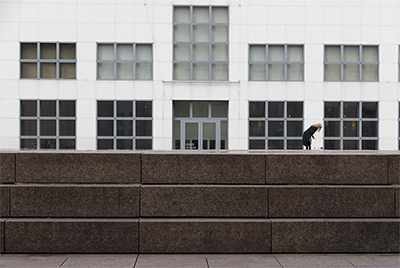
Leading lines—pavements, rails, shadows, façades and sightlines—can guide the eye toward the subject. Repeated shapes can create rhythm, while a single person breaking that repetition can create tension. These are not formulas; they are ways to make the route through a photograph intentional.
The rule of thirds is a useful starting point, not a rule to obey in every frame. Place a subject near a third when it creates balance or a sense of movement. Put the subject in the centre when symmetry, directness or eye contact is the point. The composition should serve the photograph, not the grid.
Frame people with the street, not against it
Doorways, windows, bus shelters, reflections and gaps between buildings can all frame a subject. A frame within the frame gives the eye a place to settle and can make a crowded city feel ordered. It also helps a person feel connected to a specific place rather than dropped into an anonymous background.
Use negative space in the same way. A broad wall, sky or shadow may look empty, but it can amplify a small gesture or isolate a person from visual noise. If the empty area does not add direction, mood or balance, it is probably just unused space.
A simple practice for better street photography framing
Instead of moving on after one frame, work a promising scene for a few minutes. Make a wide photograph to understand the setting, then a tighter frame. Change height, move a few steps sideways and watch what happens when different people pass through. This practice builds the ability to see relationships before the decisive moment arrives.
Review the sequence later. Do not only ask which image is sharpest. Ask which frame has the clearest idea, the most useful background and the strongest relationship between subject and place. That is how composition becomes a habit rather than a checklist.
Street photography composition questions
What makes a good street photography composition?
A good street photography composition makes the main idea easy to see while leaving enough detail to create context. The viewer should understand where to look first, then discover the relationships that make the image worth returning to.
How should I use the rule of thirds in street photography?
Use it to test balance, not to force every subject onto a grid line. If placing a person near a third strengthens the direction of movement or opens useful space in the frame, it helps. If a centred composition is clearer, use the centre.
How can I improve my framing on the street?
Slow down before you take the photograph. Check the edges, separate the subject from the background and move your feet before reaching for a different lens. Small changes in position usually improve a frame more than extra equipment.
Is strong composition enough to make a good street photo?
No. Composition gives an image structure, but timing, light, gesture and meaning give it life. The most memorable photographs bring those elements together without making the technique feel more important than the moment.
For the next step, pair deliberate framing with patience and observation. The related guide on candid and posed street photography explores how the photographer’s relationship with a subject can change the story a frame tells.